




















Blog
How to Choose the Right Garbage Bag Size and Micron Rating for Every Workplace Bin

A liner that is too small will split the moment someone forces it over the rim. One that is far too big ends up with metres of wasted plastic, awkward overhang and unnecessary spend. Thickness is just as important. A thin bag may cope with office paper but fail spectacularly when food waste or jagged offcuts go in. By taking a few minutes to understand bag sizing, litre capacities and microns, facility managers can slash liner waste, reduce staff complaints and avoid messy leaks. This guide walks through the essentials, shows you where manufacturers hide the size specs and explains when it is worth moving up to a heavier gauge. If you already know you need cartons delivered nationwide, our wholesale garbage bag range covers every common bin size in Australia.
Why Bag Size and Thickness Matter More Than You Think
Garbage bags look simple, but they are engineered products. Two numbers dictate how well a liner performs:
- Bag dimensions – the flat width and length when the bag is laid out flat determine whether it fits the bin without excessive overhang.
- Micron rating – the thickness of the plastic, measured in micrometres (µm), affects puncture resistance and load capacity.
Pushing a bag beyond its design limits leads to double-bagging or emergency clean-ups. In many offices, that equals extra labour and plastic waste. In healthcare or food production settings it risks of contamination and compliance failures. Understanding specifications up front prevents these flow-on costs.
Local example: Melbourne CBD offices that adopted a size-specific liner program saw an average 14 percent reduction in liner usage per floor just by matching desk-side bins to 15-litre bags instead of “whatever is on the trolley”.
Quick Guide: Matching Common Australian Bin Volumes to Bag Sizes
The chart below shows the most common indoor and outdoor bin volumes found in Australian workplaces and the liner dimensions that usually fit best. Use it as a starting reference before measuring your own bins.
| Common Bin Volume (L) | Typical Bag Dimensions (mm) | Suggested Micron Range | Common Workplace Use |
| 15 L desk side | 350 W × 570 L × 590 H | 10–12 µm | Under-desk paper and soft waste |
| 30 L office | 450 W × 600 L × 700 H | 12–15 µm | Tea-room, mixed recyclables |
| 60 L kitchen swing | 550 W × 810 L × 950 H | 15–18 µm | Break-room food waste |
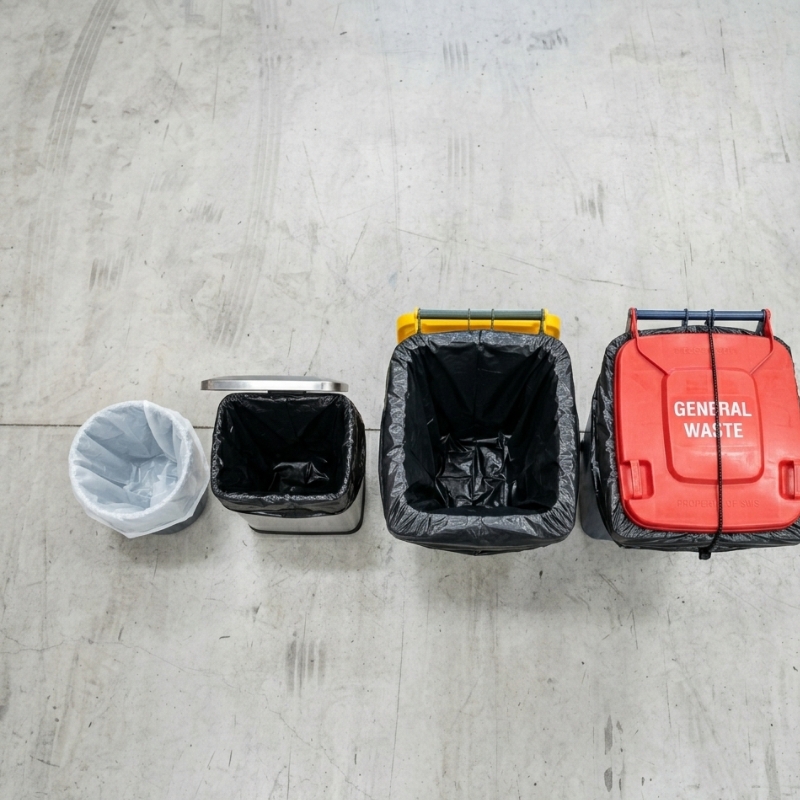
| 120 L wheelie | 780 W × 1 120 L × 1 350 H | 22–30 µm | Warehouse or high-traffic corridors |
| 240 L wheelie | 1 150 W × 1 460 L × 1 550 H | 30–40 µm | Bulk cardboard, heavy mixed waste |
Note: Dimensions include side gussets. Always confirm your bin’s rim diameter and height because brands vary by a few centimetres.
Choosing the right length is the most common stumbling block. Aim for enough slack to fold over the rim by 150–200 mm so cleaners can knot or tie the bag without stretching.
Understanding Micron Ratings: Thickness, Strength and Waste Type
A bag’s micron (µm) rating directly impacts how much weight and what type of waste it can handle. High-density polyethylene (HDPE) liners often use lower microns with strong tensile strength, while low-density polyethylene (LDPE) liners rely on higher microns for toughness.
| Waste Type | Minimum Recommended Micron | Why That Thickness Matters |
| Shredded paper, tissues, soft plastics | 10 µm | Light, non-sharp waste has low puncture risk |
| Canteen food scraps, coffee grounds | 15 µm | Moisture can pool; thicker film resists tears when lifting |
| Broken crockery, disposable cutlery | 22 µm | Sharp edges can pierce thin liners |
| Manufacturing offcuts, metal shavings | 30 µm | Requires heavy-duty, tear-resistant film |
| Confidential documents for shredding | 15 µm (opaque) | Thicker opaque film prevents visibility and accidental tearing |
It is tempting to buy one thickness for the entire site, but mixing thicknesses often saves money. A national logistics firm in Brisbane switched to 12 µm liners for office areas and 30 µm for dispatch docks, cutting liner costs by nine percent without a single increase in split bags over six months.
Signs You’re Using the Wrong Bag (and What It Costs You)
- Frequent double-bagging – cleaners automatically line bins twice because one bag tears.
- Excessive overhang – more than 30 cm of bag hangs over the rim, wasting plastic.
- Stretch marks or thinning – plastic looks transparent near the rim after tying off.
- Leaking fluids – thin liners allow seepage from coffee grounds or food waste.
- Spillage during removal – bag tears when lifted, leading to extra cleaning time.
Hidden cost example: A Sydney food court swapped to a heavier 30 µm liner and eliminated 20 minutes per shift of spill clean-ups, freeing staff to service tables instead.
Practical Checklist for Measuring Your Existing Bins Accurately
- Measure rim width (W): Use a tape measure across the longest point, including any lip.
- Measure rim depth (D): Measure the shorter side if your bin is rectangular.
- Calculate linear width: (W + D) × 2 ÷ 2. This gives the minimum flat width of the bag.
- Measure bin height (H): From the floor to the top rim.
- Add cuff allowance: Add 150–200 mm to H so the bag can fold over the rim.
- Check liner length: Use H + allowance as the minimum bag length.
Tip: Convert all measurements to millimetres to match most Australian liner spec sheets.
Storage and Handling Tips to Preserve Bag Strength in Bulk Cartons
Buying by the pallet is economical, but incorrect storage can weaken plastic over time.
- Avoid direct sunlight: UV light degrades polymer chains, causing brittleness.
- Rotate stock: Use first-in-first-out (FIFO) to avoid cartons sitting for years.
- Keep below 35 °C: Warehouses in Darwin and north-west WA can reach high temps. Prolonged heat softens bags, making them prone to stretching.
- Stack evenly: Crushing lower cartons can crease liners, which become tear points when stretched.
- Seal opened cartons: Dust and airborne oils can cling to liner folds and reduce clarity or hygiene.
Decision Framework: When to Upgrade to Heavy-Duty or Compostable Liners
Not every bin needs a 30 µm liner, but certain triggers justify an upgrade.
Heavy-Duty Plastic
Choose 26–40 µm if:
- The waste stream regularly includes sharp edges, broken glass or heavy liquids.
- Bags travel long distances before disposal (e.g., stadiums, airports).
- Complaints about leaks or tears are regular despite correct sizing.
Compostable Liners
Choose liners that meet AS 4736 or AS 5810 if:
- Your site participates in an organic waste collection service.
- State single-use plastic bans affect your venue (e.g., SA, QLD, ACT).
- Food waste constitutes more than 50 percent of bin contents.
A helpful next step is to explore broader wholesale advantages for consumables such as wipes, cloths and dispensers. See the benefits of ordering cleaning supplies wholesale for practical savings you can replicate across multiple product lines.
Official Guidance on Plastic Waste in Australia
The Australian Government’s Department of Climate Change, Energy, the Environment and Water outlines national goals to reduce problematic plastics, including lightweight shopping and produce bags. Keeping an eye on these developments helps buyers plan alternative liner materials ahead of regulation changes. Read the current roadmap via the Department of Climate Change, Energy, the Environment and Water for official updates.
What to Watch
- State variations – each state and territory sets its own timelines for phasing out certain bags.
- Certification – compostable liners should carry the seedling or home-compost logo.
- Reporting – large corporations may soon need to report on plastic packaging and liner usage.
FAQs
1. What happens if I use a bag that is too thick for light waste?
You will pay more per liner and generate unnecessary plastic waste. Thin office waste rarely needs more than 12–15 µm. Stick to the lowest micron that does not rip when removed.
2. How do I know if a compostable liner is certified in Australia?
Look for the AS 4736 or AS 5810 logos, often called the “seedling logo”. Without that mark, the liner may not break down in industrial composting facilities and could be rejected.
3. Are wheelie-bin liners essential, or can I load waste directly into the bin?
Liners reduce washing time and prevent odour build-up. Where weight or sharp gravelettes are significant, heavy-duty wheelie-bin liners protect the bin from gouges and early replacement.
4. Does colour matter when selecting workplace bin liners?
Yes. Many facilities follow colour coding for recycling streams (e.g., green for organics, yellow for co-mingled). Using coded liners helps cleaners identify the correct disposal path quickly.
5. How long do garbage bags last in storage?
When stored out of sunlight, below 35 °C and in sealed cartons, HDPE and LDPE liners can retain strength for up to three years. Compostable liners have a shorter shelf life (roughly 12 months) because the material is designed to break down faster.
Wrapping Up
Matching bin dimensions and micron ratings does more than stop mid-shift spills. It cuts liner usage, keeps staff safe from leaks and positions your organisation for upcoming plastic regulations. Measure your bins, select the lowest micron that handles the heaviest expected load and store cartons correctly. When specification questions arise, your wholesale supplier can provide sample rolls before you commit to a pallet. Thoughtful selection now prevents costly clean-ups later.