





















Blog
How Much Washroom Stock Does Your Site Actually Need? A Headcount Method

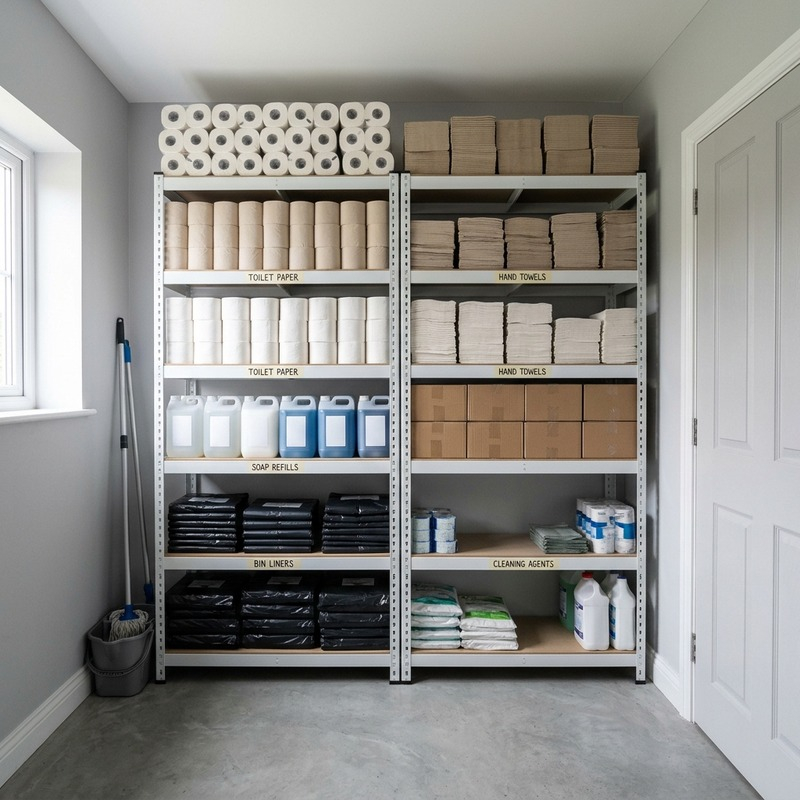
Two things cost a site money, and they pull in opposite directions. Running out mid-week means someone walking to the supermarket and paying retail for a packet that was never meant to be bought that way. Over-ordering means a storeroom holding six months of a refill that no longer fits the toilet paper dispensers on the wall after the next refurbishment.
Both come from the same habit: ordering when the cupboard looks empty. What follows is a headcount-based method you can run on your own site in about twenty minutes, using numbers you already have.
Why “order when it looks empty” costs more than it saves
The obvious cost is the emergency top-up. Someone notices the last roll on a Wednesday, and the fix is a trip to the nearest supermarket at retail pricing, plus the half hour it takes, plus the packet that turns out not to fit the dispenser and ends up sitting on the cistern.
The less obvious cost runs the other way. Panic buying is usually followed by over-ordering, and bulk stock takes up floor space you are already paying for. Cartons stored in a damp or crowded room get damaged, and the moment a dispenser is replaced or a washroom is refurbished, every refill bought for the old unit is stranded.
What makes both avoidable is that washroom consumption is not random. It tracks four things, and once you separate them you can forecast it closely enough to order on a schedule instead of on a hunch.
The four things that set your consumption
Headcount, and how many of those people are on site
Payroll headcount is the wrong number. What drives consumption is average daily occupancy, meaning how many people are actually in the building on a normal day.
Hybrid working broke every rule of thumb built on staff numbers. A business with a hundred people on the books might have sixty in on a Tuesday and twenty on a Friday, and ordering for a hundred wastes money while ordering for twenty guarantees a shortfall.
Take a fortnight of real occupancy, from sign-in records, access card data, desk bookings or a simple tally at reception. Average it, and note the busiest day separately, because that day is what your par level has to survive.
Visitors and public access
A site with public or customer washrooms consumes far more than its staff count suggests, and the gap can be large enough to make staff-based ordering useless on its own.
Retail floors, clinics, venues, gyms, cafes and warehouses with visiting drivers all fall into this group. The people using those washrooms never appear on any internal headcount.
Estimate visitor volume separately rather than padding the staff figure. Door counters, booking systems, transaction counts or appointment schedules all give you something defensible. Where none of those exist, observe the busiest day you have and use that as the allowance. Add it to occupancy as its own line, so you can adjust it later without unpicking the whole calculation.
Dispenser type and capacity
This is the single biggest lever on the list, and it works on two things at once.
The dispenser dictates the refill unit, so it sets what you order. It also sets how much that unit holds, which decides how often someone has to walk to that washroom and open it. A higher-capacity unit cuts restocking labour as much as it cuts the risk of running out mid-shift, which matters most in the washrooms furthest from the storeroom.
Format also changes consumption per use. A controlled-feed dispenser releases a set amount each time it is used, while an open format leaves the amount entirely to the person using it, and the two produce noticeably different usage from the same number of visits. If you are weighing up which format suits a site, our piece on jumbo versus standard toilet roll systems covers that comparison properly.
Washroom count and layout
The number of separate washrooms matters independently of how many people use them.
Every washroom needs a minimum par level whether it is busy or barely touched, because an empty dispenser in a quiet washroom is still an empty dispenser. Ten small washrooms spread across three floors therefore tie up considerably more buffer stock than two large ones serving the same headcount.
Layout adds to it. The further a washroom sits from the storeroom, the more it pays to hold a little extra there rather than making the trip twice.
A headcount method you can run in twenty minutes
Six steps. None of them needs product knowledge, and none of them needs a number you do not already have.
- Establish average daily occupancy. Take two weeks of actual attendance, average it, and record the busiest single day alongside the average.
- Add a visitor allowance. Estimate visitor numbers from whatever count you have, and record it as a separate figure rather than folding it into occupancy.
- Walk the site and record what is installed. Count the washrooms, count the dispensers in each one, and write down the refill each dispenser takes. The make and model are usually printed inside the cover.
- Set a par level per washroom. Enough refills to cover the gap between restock visits, plus one spare per dispenser so nothing ever hits empty.
- Set a reorder point. Par level plus one full restock cycle of stock, so an order placed at that point arrives before you reach par.
- Calibrate for one month. Note the date each washroom is actually restocked. After four weeks the real consumption rate is in front of you, and the par levels can be adjusted to it.
Why the dispenser decision comes first
Most sites run this order backwards. They buy the consumable, then discover what it does or does not fit.
The dispenser determines the refill, not the other way around, so any dispenser change mid-stream orphans whatever stock is already on the shelf. If a refurbishment or a replacement is coming, make that decision before the next bulk order rather than after it.
The second thing worth doing is standardising. A site where every washroom takes the same refill holds one line of stock instead of four, orders in larger units, and never has a situation where the only spare refill in the building is the wrong one.
Where pilferage or heavy over-dispensing is an issue, lockable units are worth specifying at the same time, since they are far easier to install as part of a planned change than as a reaction later.
Hand towels, soap and bin liners follow the same logic
Hand towels behave much like toilet paper, except usage tracks hand washes rather than cubicle visits, so a site with a busy kitchen or a lunchroom consumes more than its washroom traffic suggests. Count the dispensers, record the fold the unit takes, and set a par per washroom the same way you did for toilet rolls. The range of hand towels and dispensers runs to several folds that are not interchangeable, so matching the refill to the installed unit matters here more than anywhere.
Soap is simpler to count and easier to get wrong, because a cartridge or bottle empties invisibly until it is empty. Record the unit each dispenser takes, hold one spare per washroom, and check levels on the same walk you do for paper. The format of your hand soap dispensers decides whether you are ordering cartridges or bulk refill, which is a decision worth settling site-wide rather than washroom by washroom.
Bin liners come down to one measurement rather than consumption rate, and that is the bin itself. A liner cut for a larger bin wastes material on every change and a tight one splits, so measure the bins you actually have before ordering garbage bags and bin liners in bulk. Beyond that, the par level follows the number of bins and how often they are emptied.
What to check before you order
- Every refill on the order matches a dispenser that is actually installed.
- Par levels are set per washroom, not as one figure for the whole site.
- The visitor allowance is included rather than assumed to be covered by staff numbers.
- Bin liners are sized to the bins you have, not to the last ones you bought.
- Bulk pack sizes physically fit the storage space available.
- One named person owns restocking, so the record sheet stays current.
From reactive to planned
The difference between a site that runs out and a site that does not is rarely budget. It is whether anyone has written down what each washroom holds and what it gets through. Twenty minutes with an occupancy figure, a visitor estimate and a walk around the building gives you par levels and reorder points you can hand to whoever places the order, and the same method runs again next quarter when occupancy shifts.
Related Posts
Cleaning Gym Equipment Without Wrecking It: What’s Safe on Vinyl, Foam and Chrome


Commercial Kitchen Cleaning: Choosing the Right Chemical for Each Task
How Much Washroom Stock Does Your Site Actually Need? A Headcount Method
Floor Pad Colour Codes Explained: Which Pad for Which Job
Choosing a Backpack Vacuum for Commercial Sites: Weight, Filtration and Run Time
Jumbo vs Standard Toilet Roll Systems: Which Suits Your Washroom
Choosing a Commercial Dustpan and Brush That Actually Lasts
Foaming vs Liquid Hand Soap: Which Is Better for Busy Workplace Washrooms?

How to Use a Window Squeegee for Streak-Free Windows

How Long Does an Air Freshener Refill Really Last in Busy Workplaces?
Choosing the Right Cleaning Glove Size and Thickness to Keep Work Moving

Which Cleaning Items Actually Cut Your Monthly Budget in 2026?