




















Blog
Floor Pad Colour Codes Explained: Which Pad for Which Job

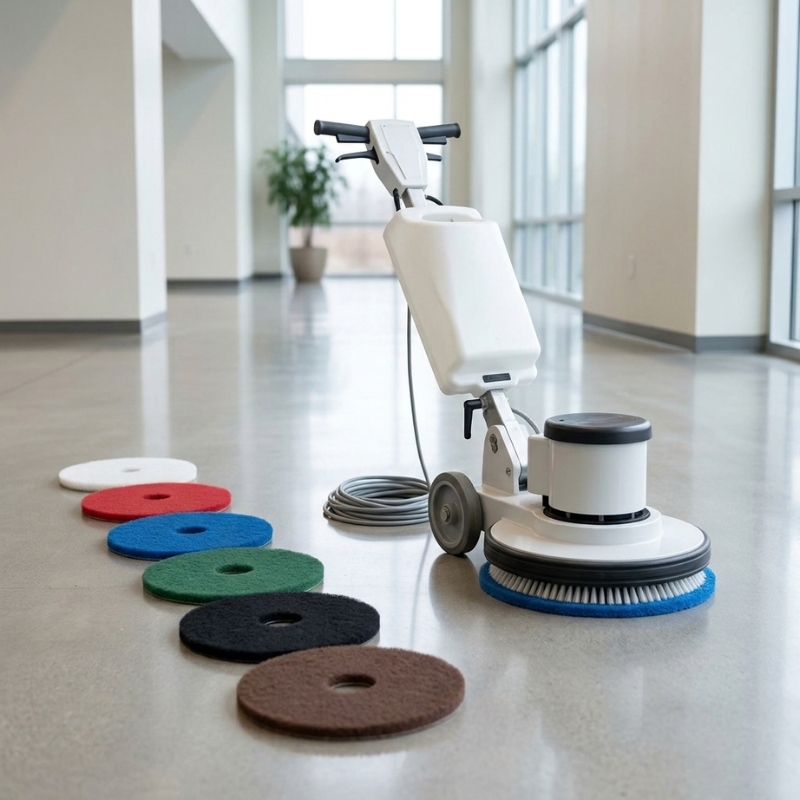
Floor pads follow a colour code, and once you know it, choosing the right one stops being guesswork. The colour tells you how aggressive the pad is, which tells you the job it is built for, from stripping an old finish right back to buffing a floor to a shine. Use the wrong colour and you either damage the floor or waste effort achieving nothing. This guide sets out what each colour conventionally means, how the main jobs differ, and how to match a pad to your floor, your machine and the task in front of you.
The full floor pads and brushes range carries the colours and grades described below, so you can match what you read here to what you need.
What the floor pad colours mean
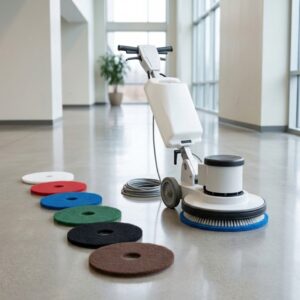
The colour code runs roughly from light and gentle to dark and aggressive. Lighter pads do fine, polishing work, while darker pads do the heavy, abrasive work. This is the conventional guide most suppliers follow:
| Pad colour | Typical job |
| White | Polishing and light buffing on finished floors |
| Red | Buffing and light cleaning, spray cleaning |
| Blue | Scrubbing and general wet cleaning, light finish removal |
| Green | Heavy scrubbing and preparing a floor for stripping |
| Black | Aggressive stripping of old finish and heavy build-up |
| Brown | Heavy stripping, among the most aggressive |
Treat this as the conventional guide rather than an absolute law, because some ranges vary slightly. The principle holds everywhere though: the lighter the pad, the finer and gentler the work, and the darker the pad, the more aggressive it is. When in doubt, start lighter and step up, because a gentle pad that is too soft wastes a little time, while an aggressive pad that is too harsh can damage the floor in seconds.
Stripping, scrubbing, buffing and polishing
The four main jobs sit on a scale of aggression, and each calls for its own end of the colour range.
Stripping is the heavy end: removing old floor finish, sealer or built-up grime right back to the bare floor, using the darkest, most aggressive pads. It is the job you do before re-coating a floor. Scrubbing is general wet cleaning that lifts dirt and light marks without removing the finish, using the mid-range pads. Buffing is lighter again, working a finished floor to smooth and refresh it, often with a spray, using the lighter pads. Polishing is the lightest, bringing up a shine on a floor that is already clean and finished, using the palest pads. Picking the pad is really a matter of deciding which of these four you are doing, since the job and the colour are two sides of the same choice.
Matching the pad to the floor finish
The floor itself has the final say, because a pad that suits one surface can ruin another.
A delicate or highly polished finish needs a gentle pad, since an aggressive one will scratch or dull it and undo the look you are maintaining. A hard, robust floor built to take heavy traffic can handle the coarser pads without harm. The mistake that costs the most is reaching for an aggressive pad on a soft or finished floor to speed a job up, because the time saved is nothing against the cost of a scratched or stripped surface that then needs refinishing. Always match the pad to what the floor can take, not to how quickly you want the job done, and when you are working an unfamiliar floor, test in a discreet spot before committing to the whole area.
Machine speed and pad pairing
The pad and the machine work as a pair, and the machine’s speed should suit the pad and the job.
Lower-speed machines suit scrubbing and stripping, where the work is about abrasion and lifting material and the pad needs time to bite. Higher-speed machines suit buffing and polishing, where the speed is what brings up the shine on a finished floor. Running the wrong pairing is counterproductive: a polishing pad on a slow machine will not develop a shine, and a stripping pad on a high-speed machine is both ineffective and risky. Check that your machine’s speed range suits the pad before you start, so the two are pulling in the same direction.
When to replace a pad
A worn pad quietly stops doing its job well, so knowing when to retire one keeps your results consistent.
- It has worn thin or flattened, losing the texture that does the work, so it glides rather than cutting or polishing.
- It is clogged with finish or grime that will not rinse out, which smears the floor instead of cleaning it.
- It has torn or lost its shape, which makes it cut unevenly and can mark the floor.
- The colour has worn away, which both reduces performance and makes it harder to tell what grade you are holding.
A fresh pad cleans faster and more evenly than a tired one, so replacing a worn pad usually saves more time than it costs. As a Licenced Supplier, A C Cleaning Supplies stocks the full colour range and grades, so you can match the pad to the job. Read the colour, match it to the floor and the machine, and the job does itself.
Simple commercial floor cleaning scene showing a range of colour-coded floor pads arranged neatly beside a floor polishing machine, white, red, blue, green, black and brown pads clearly visible, clean polished floor surface, realistic professional cleaning equipment, bright uncluttered setting, no people, no text, no logos.