



















Blog
Choosing a Backpack Vacuum for Commercial Sites: Weight, Filtration and Run Time

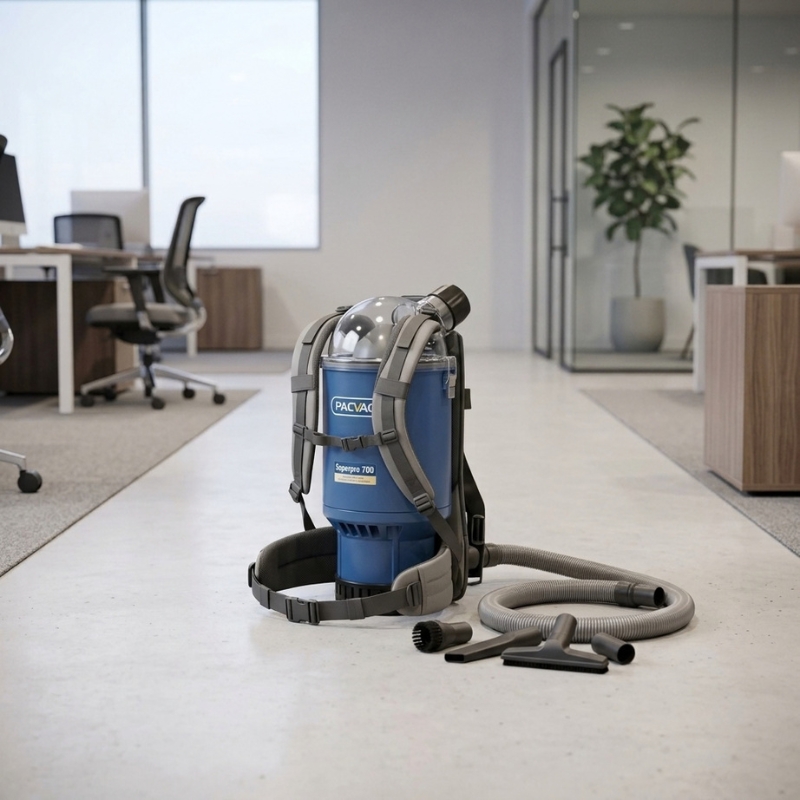
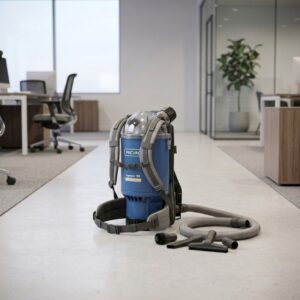
A backpack vacuum lives or dies on comfort and endurance, because a cleaner is wearing it for most of a shift. The suction is rarely the problem. What separates a unit someone can work in all evening from one that gets left in the cupboard is how it sits on the back, how long it runs before it stops, and whether its filtration suits the site it is working. This guide covers the things that actually decide that, so you buy a machine your cleaners will use rather than avoid.
If you want to see the range as you read, the backpack vacuums category has the units and the harness types referred to below.
Harness fit and carry weight over a shift
The single biggest factor in whether a backpack vacuum works for your team is how it feels three hours into a shift, not how it feels when you first lift it.
Carry weight matters, but how that weight sits matters more. A well-designed harness spreads the load across the hips and shoulders the way a good hiking pack does, so the weight rides on the body’s strong points rather than dragging on the shoulders. A poor harness puts all of it on the shoulders and upper back, and that is what turns a manageable machine into one that causes fatigue and complaints by the end of a shift. When you compare units, look past the headline weight to the harness design: padded, adjustable straps, a proper hip belt, and a frame that holds the unit off the back for airflow. A slightly heavier machine with a good harness often feels lighter in use than a lighter one with a cheap strap.
Filtration: matching the level to the site
Filtration is where the site dictates the machine, because different environments have genuinely different requirements for what the vacuum captures and holds.
| Filtration level | Typically suited to |
| Standard multi-layer filtration | General commercial floors, offices, retail, back-of-house |
| High-efficiency (HEPA-style) filtration | Healthcare, aged care, labs, and anywhere airborne particles and allergens must be contained |
A standard filtered unit is fine for everyday commercial cleaning where the job is removing ordinary dust and debris. In a healthcare or allergen-sensitive setting, the requirement steps up, because the vacuum has to trap fine particles rather than pass them back into the air. Matching the filtration to the site is not just a quality question, it is often a requirement of the environment, so confirm what the site demands before you choose, rather than buying up or down and finding out later.
Corded run length versus battery run time
How the machine is powered shapes how a cleaner moves through a site, and the two options suit different jobs.
A corded unit never runs out of charge, which makes it the dependable choice for long, continuous cleaning in one area where power is close at hand. The limit is the lead: the cord length sets how far you can roam from a power point before you are unplugging and relocating, which interrupts the flow and adds time on a large floor. A battery unit frees the cleaner from the cord entirely, which is a real advantage across open floors, up and down stairs, and in spaces where trailing a lead is awkward or a trip hazard. Its limit is run time, because the battery only lasts so long before it needs swapping or charging. The practical question is whether your sites favour uninterrupted power in a fixed area, which points to corded, or freedom of movement across a large or broken-up space, which points to battery with enough spare charge to cover a shift.
Noise and occupied-site work
Noise is easy to ignore on a spec sheet and impossible to ignore on site, particularly when cleaning happens around people.
If your cleaning runs after hours in a quiet building, or during the day in an occupied office, hotel or healthcare setting, the sound level of the machine becomes a genuine selection criterion. A loud vacuum disturbs guests, staff and residents, and in some settings it simply cannot be used while people are present. Quieter units let cleaning happen around occupants without complaint, which is often the difference between a daytime clean being possible or not. If your sites are occupied while cleaning, treat the noise rating as a hard requirement rather than a nice-to-have, and check it before anything else on units destined for sensitive buildings.
What wears out first
Knowing which parts wear helps you buy a machine you can keep running, rather than one you replace whole when a small part fails.
- Filters are the most regular consumable, since they clog and lose efficiency with use and need cleaning or replacing on a schedule.
- Hoses and wands take knocks and abrasion and are among the first things to split or crack with hard use.
- Harness straps and padding wear with daily wear and adjustment, so a unit with replaceable straps lasts longer in service.
- The motor is the long-life component, but it depends on the filters being maintained, because a neglected filter makes the motor work harder and shortens its life.
The lesson is to buy a unit whose common wear parts are available separately, so a worn hose or a tired filter is a cheap fix rather than a reason to retire the machine. As a Licenced Supplier, A C Cleaning Supplies can match units and their replacement parts, so the vacuum you buy stays in service. Size the harness to the shift, the filtration to the site and the power to the floor, and you end up with a machine your cleaners reach for.